Is buying followers worth it for a business? In our view, no. Bought followers are unlikely to become customers, and Meta’s rules forbid buying follows. TikTok says it removes fake followers, and Instagram tries not to recommend accounts that repeatedly use misleading practices to build followings. A purchase raises the counter on your profile, and from then on that counter no longer tells you what works.
The business account may look thin next to a competitor’s, a new customer might check it before calling, and an ad offers a profile full of followers by tomorrow. An empty profile feels like a closed shop, so the offer is tempting.
Is buying followers worth it? What it breaks
Buying followers creates five problems: it breaks the platform’s rules, adds accounts that rarely behave like potential customers, can distort recommendations and statistics and, in some markets, breaks the law.
Buying followers breaks the platform’s rules. Meta’s Spam policy, which covers Facebook and Instagram, does not allow “selling, buying or exchanging for engagement, such as likes, shares, views, follows, clicks”. The same policy forbids buying accounts and Pages, so a ready-made page with an audience is covered too. TikTok’s Community Guidelines list “Buying or selling followers or engagement for financial gain” as not allowed, and LinkedIn’s policies ask members not to “do things to artificially increase engagement”.
Bought followers can disappear. In November 2018 Instagram said it had auto-detected and removed fake accounts since its early days, and that third-party apps generating inauthentic likes, follows and comments break its rules. TikTok’s guidelines say that when it detects inauthentic metrics, it will “remove fake likes, followers, or other inflated signals”. Money spent on followers can disappear in the next clean-up.
Repeated misleading practices can affect recommendations. Recommendations are posts and accounts Instagram shows to people who do not follow you yet, in places like Explore and Reels. Instagram’s help page on recommendations says it tries not to recommend accounts that “Repeatedly engaged in misleading practices to build followings, such as purchasing ‘likes’.” The page gives buying likes as its example; it does not say that buying followers once has this effect. For a local business, recommendations are one of the main ways new people can find the account.
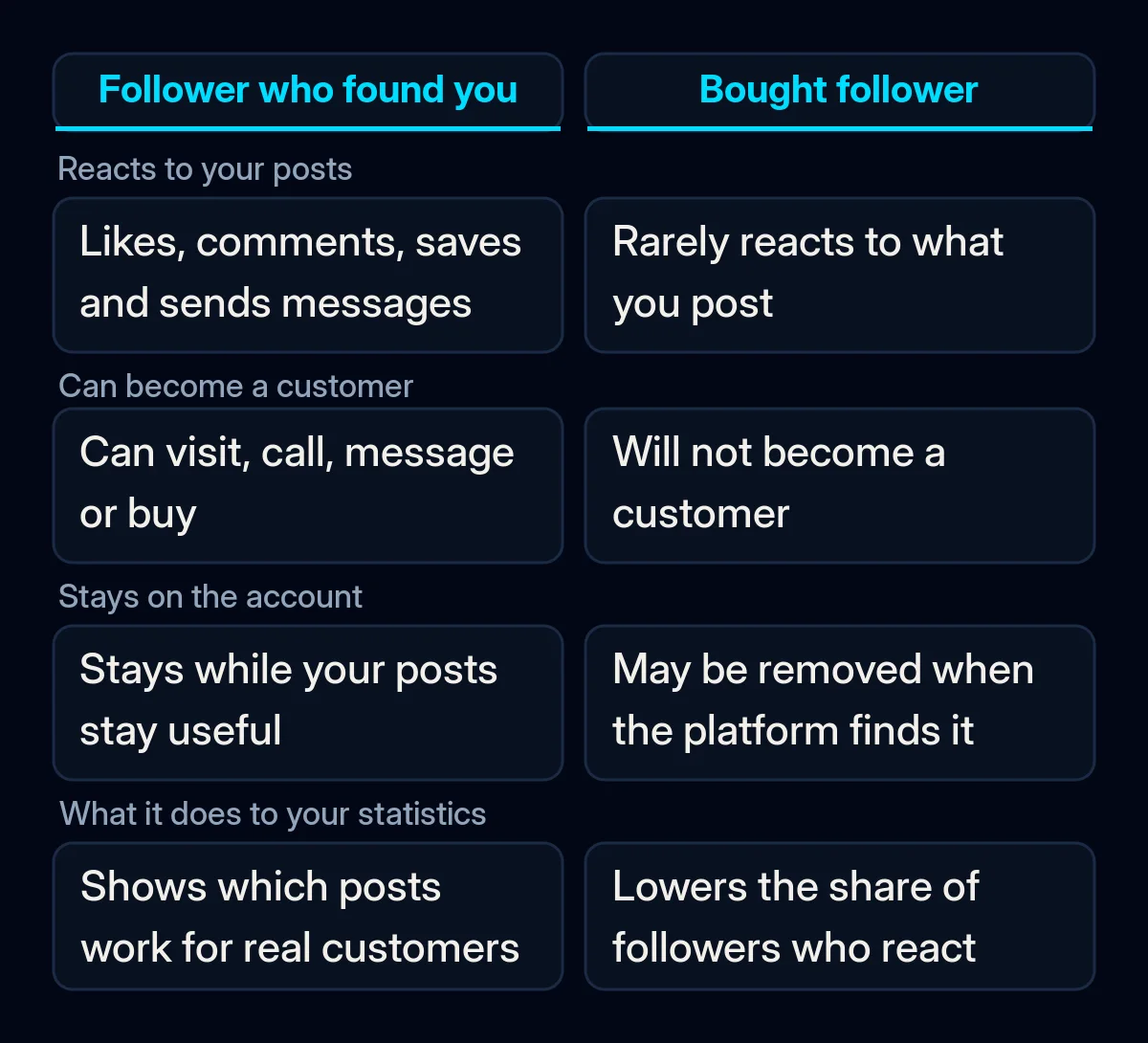
Bought followers distort your statistics. Bought accounts rarely react the way customers do, and they almost never ask questions, visit or buy. When many of your followers are bought, the share of followers who react to each post falls, even if your real customers react exactly as before.
Instagram has not published a rule that this lowers reach among your real followers, so treat that part as our reading. The certain cost is the lost baseline: you can no longer tell whether a post worked or a bought batch arrived.
Buying followers can break the law, depending on where you sell. The rules below are the ones we checked; they differ by market, and none of this is legal advice.
| Market | What the rule says | Followers named? |
|---|---|---|
| United States | FTC rule, in force since 21 October 2024: no buying fake indicators of social media influence that the buyer knew or should have known were fake and that materially misrepresent the buyer’s influence for a commercial purpose | Yes |
| European Union | Rules on unfair commercial practices, applied since 28 May 2022: no false consumer reviews or endorsements to promote products | No; the directive’s recitals give likes on social media as an example |
| United Kingdom | DMCC Act 2024, Schedule 20: no fake consumer reviews | No |
| Switzerland | Unfair competition law: no misleading information about your own business | No |
The US rule lists followers, views and likes among the indicators of influence. Endorsements are public signs of approval, and the EU directive behind the European row says traders should be prohibited from “submitting fake consumer reviews and endorsements, such as ‘likes’ on social media”. The platform rules apply in every market.
How to tell if your followers are real
You can check your audience with the platform’s own statistics, without handing your password to an outside service. Instagram’s help warns that “you shouldn’t use apps that offer likes and followers in exchange for your Instagram login details”, because such apps “can gain complete access to your account”. Instagram Insights, the statistics built into the app, are free for public accounts, and the checks below use them.
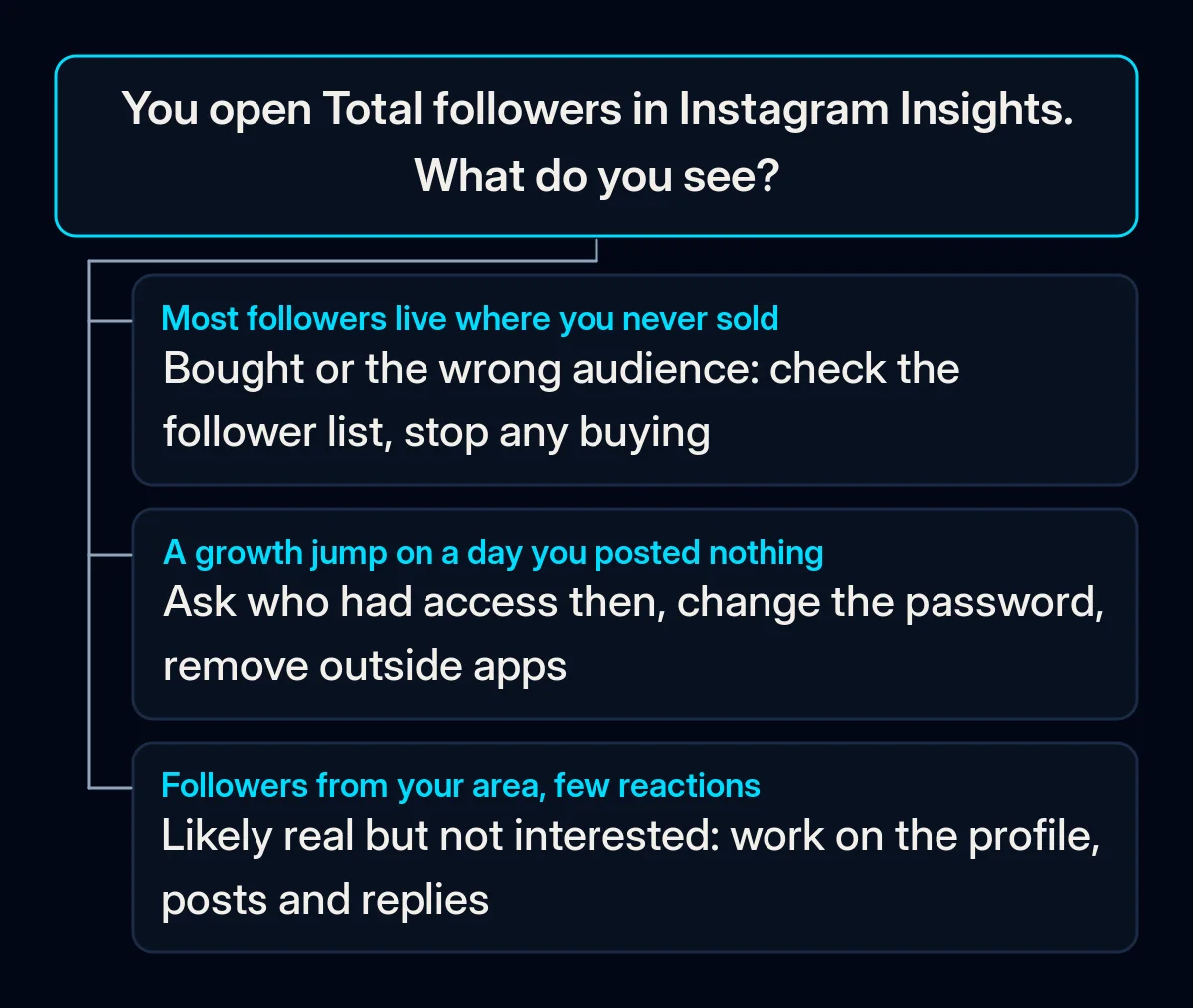
- Look at where your followers are. In Insights, open Total followers, which appears once you have at least 100 followers, and read Top locations. If a bakery in Lyon has followers who mostly live in countries it has never sold to, it may have bought followers or attracted the wrong audience. This is our check; Instagram does not describe Insights as a tool for finding fake accounts.
- Look at the growth line. Total followers also shows Growth. A jump on a day when you posted nothing and ran no ads deserves investigation, including whether a former agency or employee once bought followers for the account.
- Compare followers and non-followers among people who react. Accounts engaged counts the accounts that interacted with your posts, and Instagram splits it into followers and non-followers. If a large follower base barely appears among the people who react, many of those followers are either not real or not interested.
- Scroll the follower list. When we audit an account, we look for followers with no profile photo and no posts. We also look for the same short comment under different posts and a sudden batch of followers from one unfamiliar region. If your own account follows far more accounts than follow it back, someone may have used a follow-for-follow tool in the past. Such a tool follows strangers in the hope they follow back.
Real followers can still be the wrong audience. Whether they are potential buyers or friends, staff and peers is a separate check, covered in our guide on why a growing page can still bring no clients.
What to do instead of buying followers
Followers who can become customers come from people who already know the business and from people who find a useful post. Start with the steps that cost only time, and spend money last, on posts that have already proven themselves.
- Make the profile worth following. The first line says what you do, for whom and where, and the profile link goes to the page for the service you post about most.
- Invite the people who already know you. Customers at the counter, your email signature, receipts, your website and printed materials can all point to the account. On a Facebook Page, you can also invite your Facebook friends to follow it.
- Post on a rhythm you can keep, and reply to everyone. Bursts followed by silence make an account look abandoned, and replies turn a comment into a conversation. Our rule in client work is to answer comments and messages within one business day.
- Take part where your customers already talk. Local groups and community pages reward useful answers on the subject. A link dropped into every thread reads as spam.
- Pay to show proven posts to people you choose. Boosting a post turns it into an ad: you choose the audience who should see it, through the platform’s own ad tools instead of a third-party service. On Instagram, boosting needs a professional account, which means a business or creator account. In our social media work, we put ad money only behind posts that already work without it.
- Build credibility outside the feed. If the real reason to buy followers is to look established, recognition also comes from press, events, printed materials and a website that answers questions. A useful sign is a growing number of people searching for your business by name, which is how we measure brand and press work.
What if you already bought followers?
Stop, secure the account and reset your baseline. Stopping prevents further purchased batches from being added, and the decision about the account can then rest on real numbers. The steps below protect the account and give you a starting point to measure from.
- Cancel any growth service and do not renew it.
- Change your password if a service had your login. When Instagram began removing inauthentic activity, it asked affected users to secure their account by changing their password. Also revoke the service’s access to your account, as Instagram’s help recommends for suspicious third-party apps.
- Do not count on removing bought followers by hand. Instagram’s help describes removing followers only for private accounts, and the follower is not notified, so clearing a bought batch by hand is slow work.
- Write down today’s numbers and judge all new work against them.
- Decide whether to clean up or start fresh. In our view, a small bought batch on an account with a real history is worth keeping and outgrowing. An account built mostly on bought followers may be better replaced with a new one. If you keep the account, our guide on restarting a quiet account covers the first weeks.
What to measure instead of the follower count
Measure people who can buy and what they do, on a fixed schedule, and keep these numbers apart from the follower total. Compare each check with the numbers you recorded before any change, so that a bought batch or one popular post does not hide the trend.
- Enquiries that came from social media, recorded with their source in your CRM or enquiry log.
- Accounts engaged, split into followers and non-followers, to see whether real people react and whether new people find you.
- Top locations of your followers, to see whether new followers come from the area you serve.
- Visits from your profile to your website, in your website analytics, and what those visitors did next.
Where we come in
We do not buy followers or engagement for clients, and we do not recommend it. When we audit a social account, one of the first questions is whether the audience is alive. If it is mostly bought, we say so and help decide whether to revive the account or start fresh, then measure results against that starting point. If you would like a second look at your account, a short brief describing it is enough to start.