You know the business should be posting. Customers look you up before they call, and the account still shows a post from before the busy season. Everyone on the team agrees it matters, and nobody has the hour. If you typed “no time for social media” into a search bar, this is usually what sits behind it: posting is a task with no owner, no material ready and no place in the week.
The usual conclusions are that you need a full-time social media person, that the business is too ordinary to post about, or that social media has to wait until things calm down. Most of the time it is none of these. The time goes to a few specific places, and one ordinary week is enough to see which.
Why there is no time for social media
Every post starts from a blank screen. Nobody saves anything while the work happens, so on posting day someone has to invent an idea, find a photo and write the text at once. That is the slowest way to make a post, and it is why something that should take minutes eats an evening and then gets postponed. The sign: the team’s phones are full of work photos, and none of them reach the account.
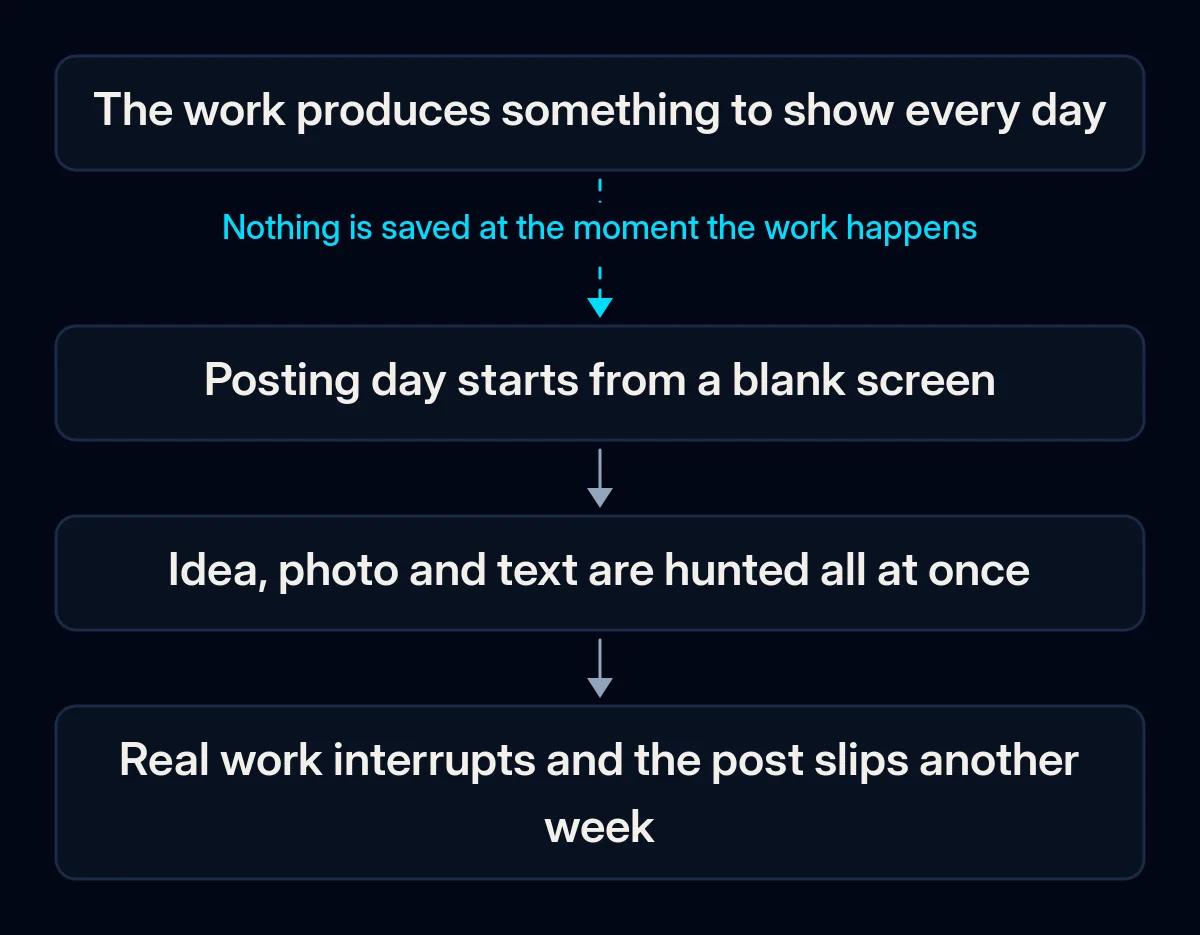
Nobody owns it. “We all post when we can” means nobody posts. Without a named person and a named day, social media is always the task that can wait until tomorrow. The sign: when you ask who posted last, the team has to go and check.
Every post waits for approval. The owner wants to see everything before it goes out, and the owner is the busiest person in the business. Drafts sit in a chat until they are out of date. The sign: finished posts that were never published.
The bar is set for a big brand. Designed graphics, perfect light, a fresh campaign idea every week. A standard nobody can meet in a real week turns into no posts at all. The sign: the last posts look polished and are months apart.
Too many platforms at once. Being everywhere splits a small amount of time into pieces too small to do anything well. The sign: several accounts, all of them quiet.
How to tell which one is yours
Take one ordinary week and go through these in order. None of them needs a paid tool, and the first check that fails is usually the answer.
- Scroll your own phone. Look for photos from this week’s work that would show a customer something: a finished job, a product arriving, a problem solved. If there are several and none were posted, material is not the problem; the process is.
- Ask who posts and when. If the answer is a name and a day, ownership is fine. If it is “whoever has time”, start there.
- Find the drafts. Look in the team chat and in each platform’s drafts for posts that were written and never published. Any you find point to approval.
- Put your last posts next to your real week. If the posts show things that needed a photographer or a designer, and your week contains none of that, the bar is too high.
- List the accounts. For each one, note whether customers ever mention it when they get in touch: ask them, or look through your enquiry notes. Accounts nobody mentions are the ones to pause.
A routine for when there is no time for social media
Cheapest first. Nothing here needs new staff or a budget; it needs one decision and one hour a week.
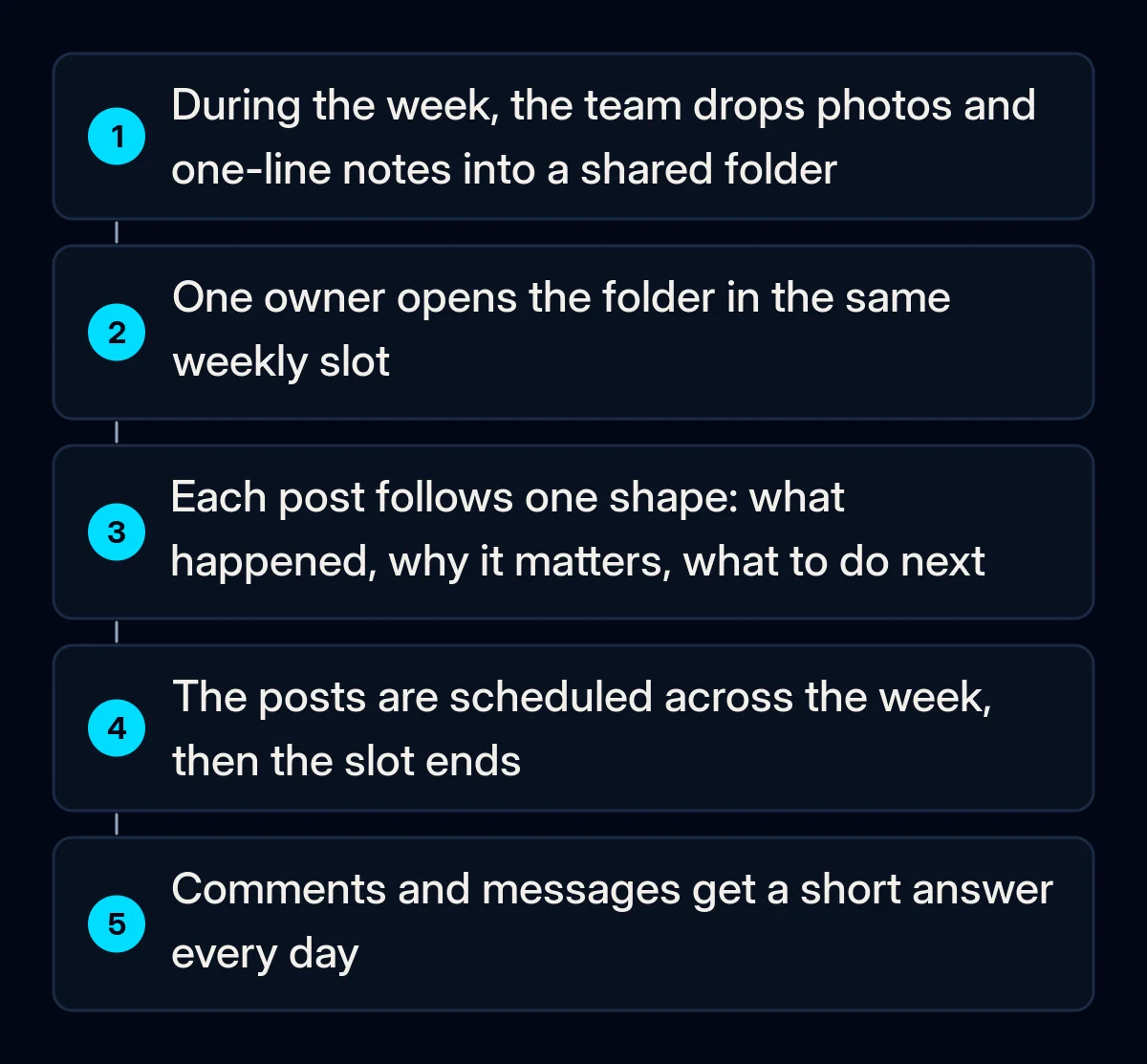
- Collect material as the work happens. Set up one shared album or folder on the team’s phones. Whoever finishes a job, unpacks a delivery or hears a good customer question adds a photo or a one-line note. It takes seconds at the moment and saves the whole evening later.
- Name one owner and one weekly slot. One person, one hour, the same day every week. Everyone else only feeds the folder. The same rule keeps an account alive after a restart; we covered the restart itself in how to revive a dead Instagram account.
- Write the week’s posts in that one sitting. Open the folder, pick a few items and write each post to the same shape: what happened, why it matters to the customer, what they can do next. A fixed shape removes the blank screen. A short note on tone — how you address customers, which words you use and avoid — lets anyone on the team write in one voice; that note is part of the brand platform and tone of voice work we do.
- Schedule, then stop. Use the scheduler built into the platform to spread the posts across the week. The hour ends when the posts are scheduled, not when they are perfect.
- Replace approval with rules. Agree once what can go out without asking — finished work, products, answers to common questions — and what needs the owner — prices, complaints, anything about a named person. Most posts then go straight out.
- Keep a few minutes a day for replies. Comments and messages are where enquiries start. The account owner, or whoever is at the counter, checks them once a day and answers briefly.
- Keep one platform. Stay on the account your customers actually mention and let the others rest with a pinned note pointing to it. Add a second only when the first runs without effort.
If even the hour keeps slipping for weeks, that is the point to hand the writing and scheduling to someone outside while the team keeps feeding the folder. In our social media management for small teams, the business keeps the folder and the conversations with customers; we turn the material into posts and keep the schedule.
What to measure
- Weeks with posts published on schedule, checked monthly; the routine holding matters more than any single post.
- Items added to the shared folder each week; an empty folder shows the habit slipping before the posts stop.
- How long the weekly slot really takes, noted by the owner; it should shrink over the first several weeks as the template settles.
- Enquiries that mention social media, asked at first contact and counted monthly; this tells you whether the platform you kept is the right one.
Where we come in
A small team with a shared folder and one hour a week can keep an account alive without outside help, and that is the point of this routine. What we bring is the setup: the post template, the tone note, the approval rules and the choice of platform, and, when the hour keeps slipping, the writing and scheduling itself. If you would like us to look at your accounts with you, a short brief is enough to start.