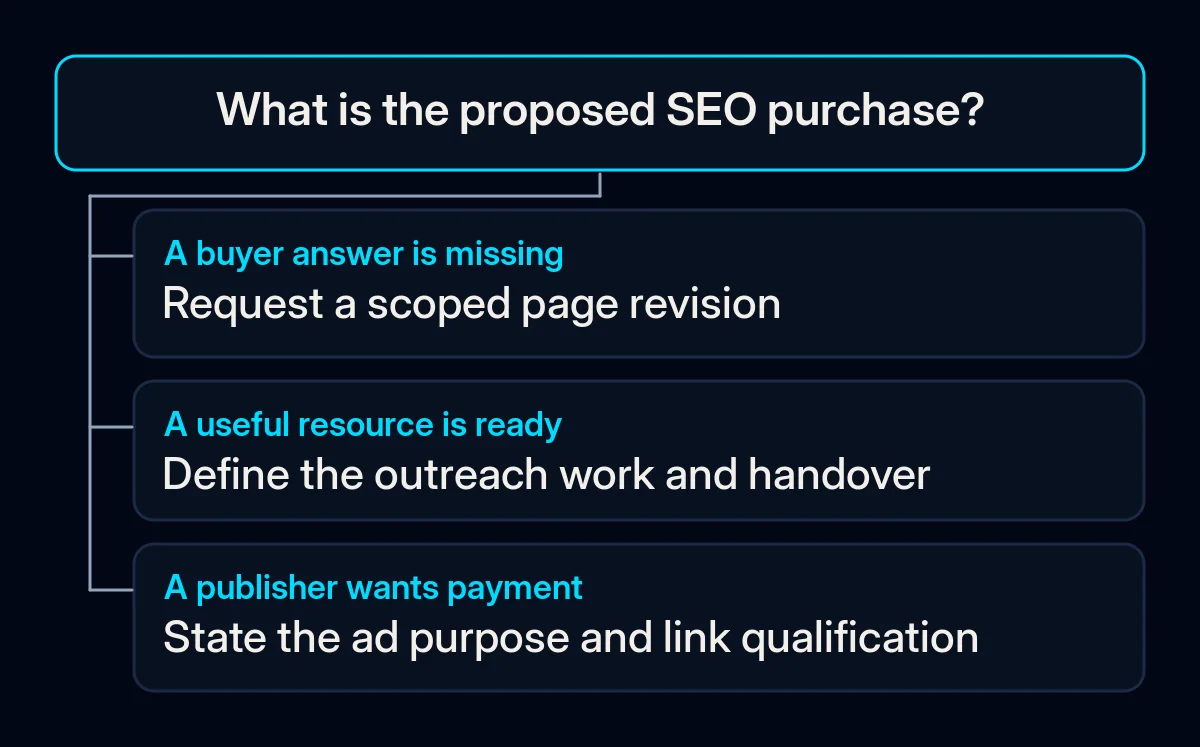
If you are weighing backlinks vs content, ask which page the work is meant to improve and what evidence supports the proposal. Commission a content fix when you can name an answer the page is missing. Consider outreach when you have something useful to share with a relevant audience. If the proposed cause is still a guess, ask for a defined diagnostic job before approving either package.
A backlink is a link from another website to yours. Content work might mean repairing a service page, writing a useful guide or checking product facts. A proposal offering a batch of links and another offering a batch of articles can leave you comparing quantities while the page a buyer actually needs receives no attention.
Backlinks vs content starts with a real page
Put the proposals beside the same business page and customer question. Ask each supplier to explain what they observed, what remains uncertain and what they would change. This gives you something concrete to compare, including the possibility that a technical problem or missing evidence needs attention before either purchase.
Choose a page that matters to the business. Write the question its visitor needs answered and the action they should be able to take afterwards. Read it yourself: can a buyer understand the offer, its key conditions and the next step? Google’s helpful-content guidance recommends checking whether content is complete and useful; a longer draft alone does not establish either.
Ask for the evidence behind technical claims too. Google’s URL Inspection documentation distinguishes information about the indexed page from a live test. An indexed status does not establish that a page appears for your intended query. Keep the indexing investigation separate; our guide to a website missing from Google covers that route.
Record the finding before discussing the package. A missing service detail is visible on the page. A claimed need for more external links is a hypothesis that needs an explanation.
Turn the finding into a work brief
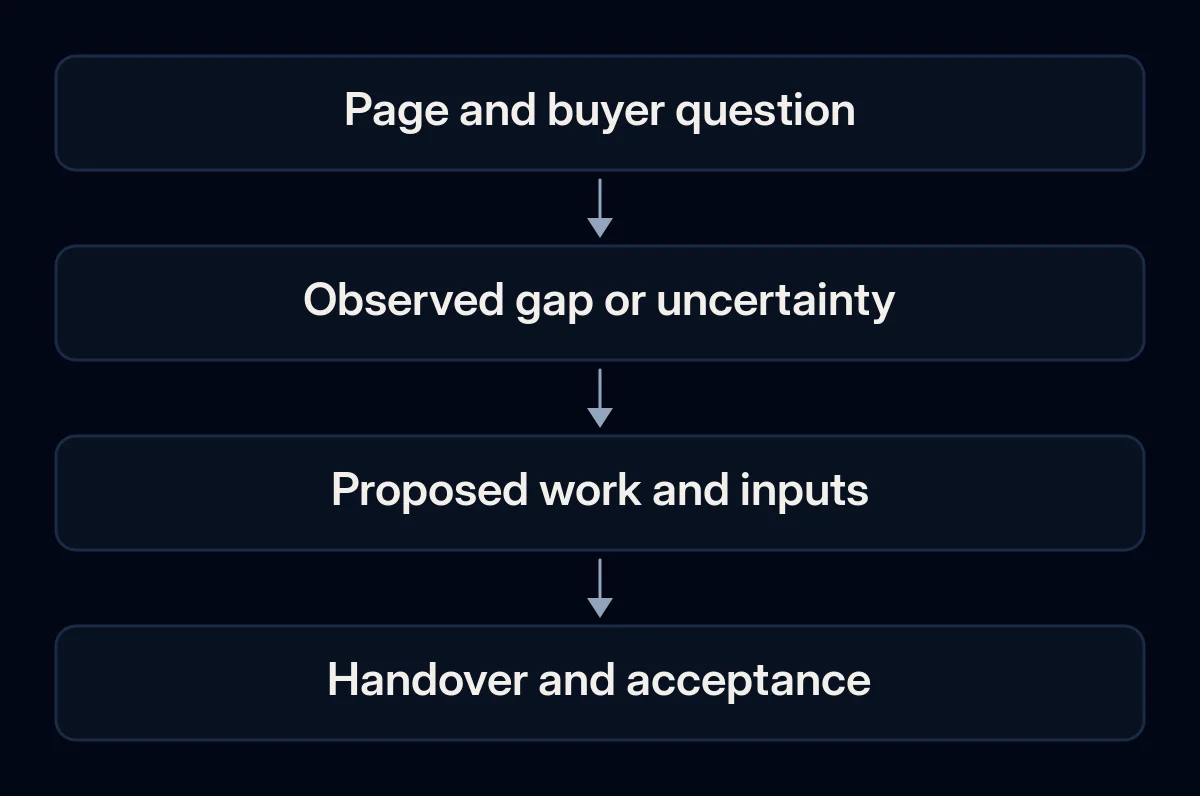
A useful proposal names the work, the inputs you must supply and what will be handed over. Ask whether the price covers advice, finished copy, implementation or the whole agreed job. You can then check the finished work against the proposal, even while its later effect in search remains uncertain.
Start with the evidence you already have:
| Finding | Work to discuss |
|---|---|
| A buyer question is unanswered | Revise the named page with verified facts |
| The proposed cause is unclear | Review the page and explain the evidence |
| A useful resource is ready | Research relevant publishers and an outreach approach |
| A technical blocker is confirmed | Specify the fix and its verification |
Use these examples to frame the discussion; your site still needs its own diagnosis. Record any missing evidence. In our SEO planning and audits, we start by connecting a proposed task to its evidence and priority. A confirmed implementation problem belongs in the scope of website work, with a named person responsible for the fix.
Copy these fields into the request you send back:
- Page and purpose. The exact address, its language and the buyer question it should answer.
- Evidence and uncertainty. The missing answer or observed problem, with the supplier’s proposed explanation marked separately.
- Work and inputs. What will change, what facts you must provide and who approves them.
- Handover. The page revision, findings note or outreach records you will receive, and who implements the agreed changes.
- Acceptance and review. How you check delivery, and when you will return to the available search and business data.
For an initial audit, Google’s hiring guidance recommends read access to Search Console. You can ask for an explanation without granting permission to change the site or account. The same guide warns that third-party tools do not have access to Google’s internal ranking data. Ask what a score actually measures before accepting it as a reason to spend.
What changes when a publisher is paid?
Separate the fee for research, writing and outreach from any payment to a publisher. Ask who receives money, what they supply and how any resulting link is treated. A label such as digital PR does not answer those questions; the proposed arrangement does.
Google’s spam policy includes buying or selling links for ranking purposes. It also permits advertising and sponsorship links when they are appropriately qualified. Google’s outbound-link guidance prefers rel="sponsored" for paid placements and still accepts rel="nofollow". The publisher applies that attribute to the link on its page.
You can commission work to identify relevant publications and prepare something their readers might use. If a publisher then asks for payment, have that placement described separately, with its advertising purpose and link qualification. Paying an outreach specialist for labour does not turn the publisher’s paid placement into an unpaid editorial link.
Before approving outreach, ask which resource will be shared, why it suits those publications and what will be delivered if editors decline. A publisher controls its editorial decision. Agree the supplier’s responsibility for research and outreach before the work starts; a promised quantity of placements said to provide ranking credit is a reason to request a different method.
Check the finished work before judging the search result
Accept delivery against the agreed scope and retain the starting evidence. A finished revision or outreach log can be inspected directly. Changes in search performance need a separate review, with dates, page context and other changes recorded alongside them.
Consider a hypothetical repair business choosing between articles and links. Its service page omits which equipment it accepts and the area it serves.
An initial brief could ask for those verified facts to be added, then require the owner to check the published page and contact route. That makes the work reviewable without assuming any traffic increase.
If the page already answers those questions and there is a useful resource for a relevant trade audience, an outreach research brief may be worth considering. That still does not prove a backlink deficit. Ask the supplier to explain the proposal’s assumptions.
At handover, open the changed page and compare it with the agreed questions. For outreach, check why each publication was chosen, the prepared material and the activity log, including nonresponses. Keep unnecessary personal contact details out of the shared report. If a placement exists, inspect its actual page and the agreed link qualification.
Google’s Performance report lets you examine queries, pages and metrics such as impressions and clicks. Save the starting period and use a comparable view when you review again. Record other changes too: a graph moving after a rewrite or a placement does not isolate what caused it. Treat enquiries and sales as separate business observations.
Where we come in
We start with the target page, the evidence for a proposed job and a handover the owner can inspect. Put the competing proposals into the five-field request above, then agree the work and its acceptance terms before committing to a continuing programme.