
Your SEO work started a while ago. Someone fixed the site, a few new pages went live, maybe you pay a monthly retainer. You open Google, type your main service and your town, and you are still not there. Enquiries look the same as before. The question you actually want answered is how long does SEO take, and whether you should keep paying while you wait.
The usual conclusions are that SEO is a scam, that the agency is doing nothing, or that you simply have to be patient for an unknown time. None of these is useful. Search shows progress in a fixed order, and each stage leaves a trace you can check yourself for free. Once you know which stage your pages have reached, “wait” and “change course” stop being a matter of faith.
Why how long SEO takes depends on your site
Where the site starts. A site that search engines already crawl often and trust gets its changes noticed quickly. A new domain, or a site with indexing problems, first has to be found and read before any ranking can happen. The sign: in Search Console, many of your pages sit in the “not indexed” part of the Pages report.
How crowded your searches are. Ranking for your business name is a different job from ranking for the main service in a large city, where established sites have held the first page for years. The more serious the pages already there, the longer it takes to be judged better than them. The sign: search your target phrase and look at who is on the first page — directories and national brands mean a long road; small local sites mean a shorter one.
What kind of change is being made. Fixing a technical error shows up as soon as the affected pages are recrawled. Rewriting an existing page is tested against competitors over weeks of impressions. Earning trust and links from other sites builds slowly and is the part nobody can rush. The sign: ask for a list of what was changed and when; if every item is of the slow kind, early silence is expected.
How often search engines come back. Small sites with few updates are visited rarely, so each change waits in a queue before anyone reads it. The sign: in Search Console, the “last crawled” date on your important pages is old.
Whether the work is continuous. SEO done in bursts with long pauses keeps restarting the clock: pages get changed, half-tested, then left. The sign: your change log has gaps longer than the work itself.
Search measures all of this in the same sequence for every change you make. A page first has to be crawled, then indexed, then shown, then clicked, and only then can it bring an enquiry.
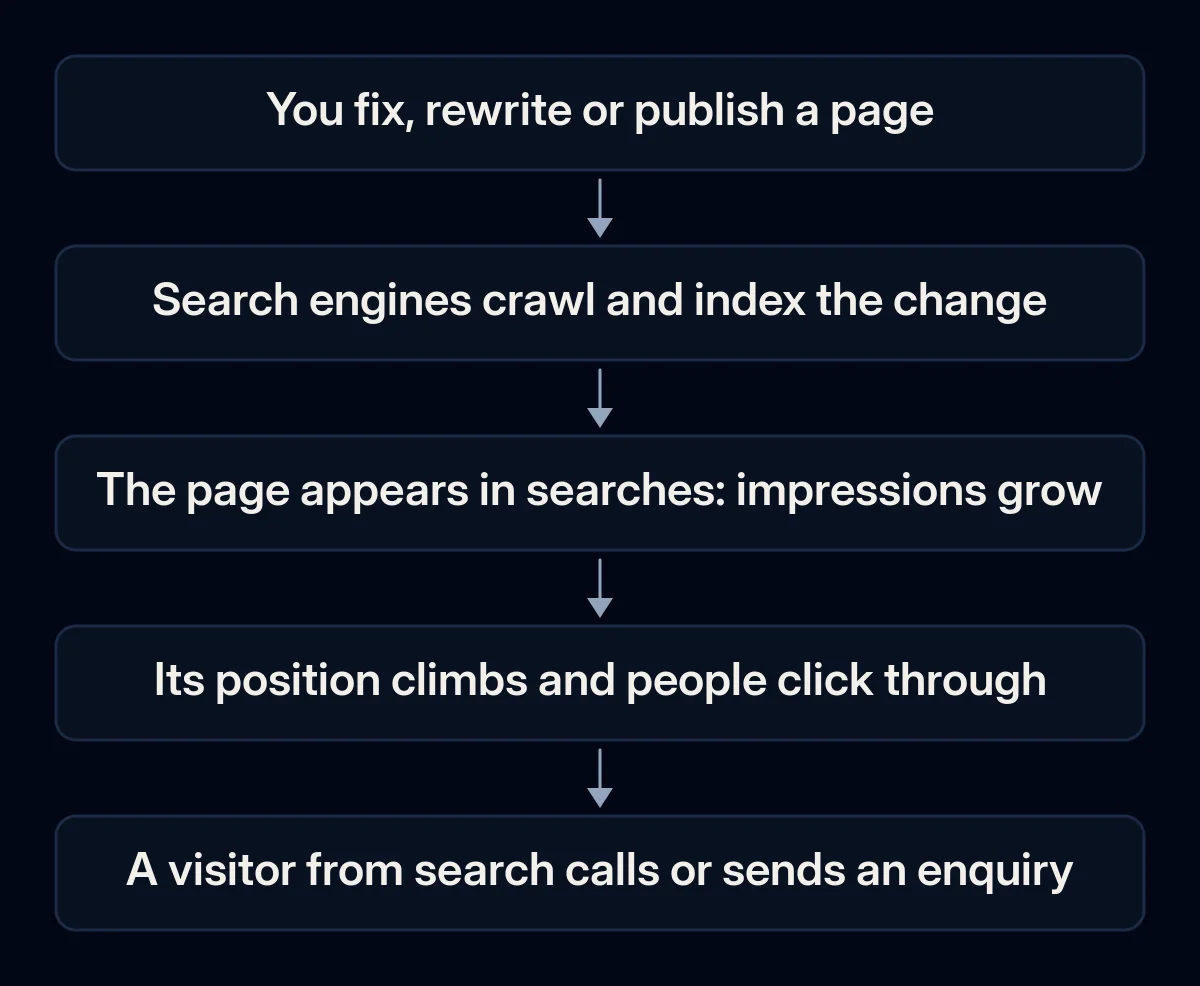
How to tell waiting from not working
Set aside an hour with Google Search Console, which is free. Go in order; the first check that fails is usually the answer.
- Are the pages you worked on indexed? Open the Pages report or inspect each URL. If the pages that were supposed to rank are not in the index, nothing downstream can move, and waiting will not change that.
- Were they recrawled after the change? URL inspection shows the last crawl date. If it is older than the change, search has not seen the work yet.
- Are impressions growing for those pages? In the Performance report, filter by page and compare the latest period with the one before the work started. Growing impressions mean search is testing the pages — this is the normal waiting stage.
- Is the average position for your target searches moving up? Filter by query. A slow climb is progress; a flat line for several monthly reviews means the pages are not yet competitive.
- Do clicks turn into enquiries? Compare organic visits with calls and forms. If clicks come and enquiries do not, SEO is working and the problem is the page or the path to contact.
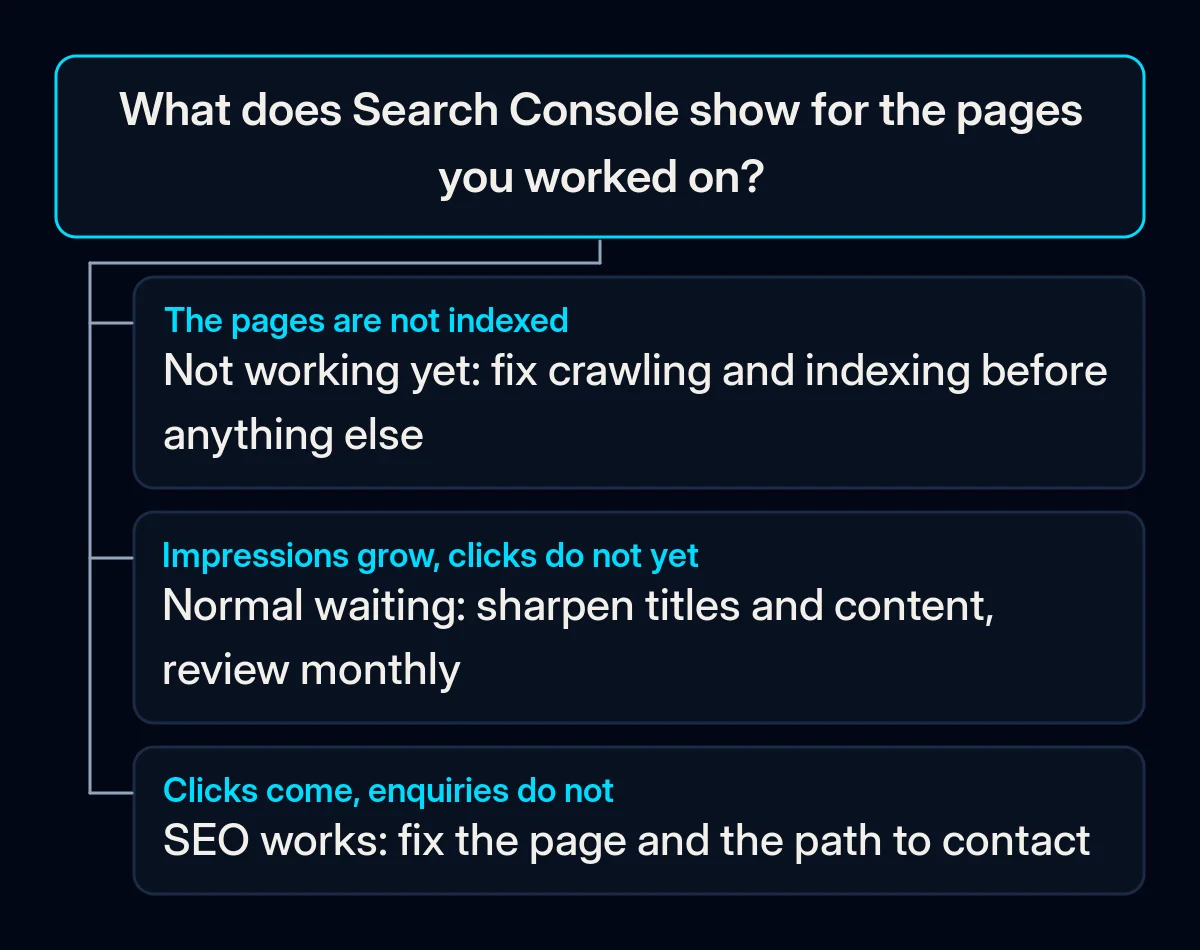
The fix, in order
Cheapest first. Most of what shortens the wait is removing things that block it.
- Record the starting point today. Export indexed pages, impressions, clicks and positions for your target searches. Without a baseline, every monthly review becomes an argument about feelings.
- Remove indexing and crawling blockers first. Pages set to noindex, blocked in robots.txt, missing from the sitemap or duplicated under several addresses stop every other effort. We covered the checks in why a website is not showing up on Google.
- Improve the pages you already have before writing new ones. An existing page that already collects impressions is closer to results than a page that does not exist yet. Match its title and headings to the search it is shown for, and answer that search on the page.
- Choose searches you can realistically win now. Start with specific services, places and questions, where the first page is not held by national brands, and work up to the crowded phrases. In our SEO work this choice comes before any writing, because it decides how long the wait will be.
- Publish on a steady rhythm, not in bursts. Regular changes keep crawlers coming back and keep testing going. If you already publish and nothing moves, the reasons are usually elsewhere; we went through them in articles that get no search traffic.
- Make sure a visit can become an enquiry. A page that ranks but loads slowly, hides the phone number or ends without a clear next step wastes the traffic you waited for. That part belongs to our website projects rather than to SEO, and it is often the quickest win of the whole list.
- Review monthly, on the same report. Same pages, same searches, same period comparison. Decisions about waiting or changing course are made there, not after a single Google search.
What to measure
- Indexed share of the pages you worked on, checked after each change; this should settle first.
- Impressions for those pages, monthly; growth here is the earliest honest sign that the work is being tested.
- Average position for your target searches, monthly; look at the direction over several reviews, not at one day.
- Enquiries from organic search, monthly, from your forms, calls or CRM; this is the stage everything else is for, and the last to move.
Where we come in
An owner with Search Console and an hour can find which stage their pages have reached and whether to keep waiting. What we bring is the order: blockers first, winnable searches before crowded ones, existing pages before new ones, and one monthly report that shows the stages rather than a single ranking. If you would like us to read your stages with you, a short brief with your site and target searches is enough to start.