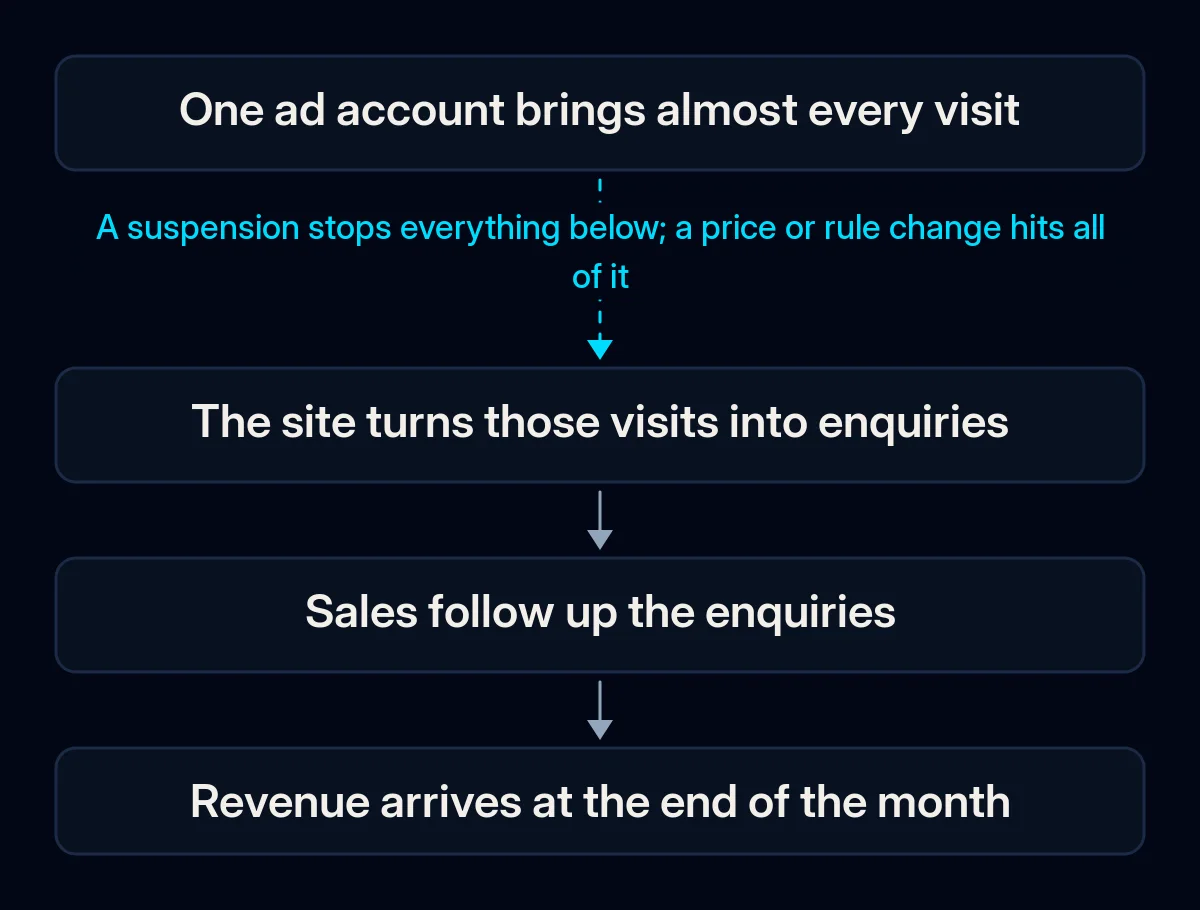
If one ad platform brings almost every enquiry, your business has a single point of failure. A suspended account can stop new customers in a day, and a price rise or a rule change can make every one of them cost more. To diversify marketing channels without wasting budget, first measure how dependent you really are. Then add one channel that fits how your customers buy, tracked the same way and tested against revenue.
Dependence on one channel usually shows up in the monthly report. Only one line matters, Google Ads or Meta, and everyone knows that a bad week there is a bad week for the whole company. Everything works today, and the open question is what happens on the day that line goes to zero.
Why one channel is a risk, even when it works
A channel that brings every lead also makes you depend on someone else’s rules, prices and systems. Each of the risks below can disrupt customer acquisition even when the channel is currently performing well. You can check how exposed you are to each one in your own reports.
An account can stop in a day. Google’s account suspension policy says that for serious violations “your account will be suspended immediately without prior warning”, and that “all ads in the suspended account will stop running”. Meta’s Advertising Standards say a restricted ad account or asset “can’t be used to advertise across our technologies”. If one account brings every enquiry, a suspension turns enquiries off.
A second account on the same platform is not a backup. Google’s policy also says “Accounts related to the suspended account may be suspended”. The same page adds that any new accounts the advertiser tries to create may also be suspended, so a spare account there can stop together with the main one.
Prices move outside your control. Meta reported that its average price per ad rose 9% over 2025. That is a network-wide average and your own price may differ. Still, it shows that ad prices can grow while your offer and your site stay the same.
Rules and algorithms change for everyone at once. Google says its core updates to search ranking come “several times a year”, and that because search results keep changing, “This constant change can cause both gains and drops in organic Search traffic”. If organic search is your only source of enquiries, those changes affect your only route to new customers.
A channel reaches its ceiling. Marketing Week described a UK cleaning brand, Purdy & Figg, that put “around 95%” of its marketing spend into Meta. Its marketing director later said the brand was on the precipice of a “performance plateau”. If more budget there no longer brings new customers at a price you can carry, the channel has reached its ceiling.
How dependent on one channel is your business?
Measure dependency by revenue from paying customers. The platform’s own report can mislead: a channel that claims every sale or enquiry may be getting credit for customers who would have found you anyway. Before you change anything, run these checks on your own data, in this order.
- List your paying customers from the last few months with their source. Use the source recorded on each enquiry; where it is missing, the answer to “how did you hear about us” is a fair stand-in. This is the base for everything else.
- Take searches for your company name out of the paid search line. People who type your brand name often heard of you elsewhere first: a recommendation, a past order, a social post. If most paid search clicks are brand searches, your search channel is partly capturing demand created elsewhere.
- Work out the share of revenue from your largest channel. Do this per month, from customers who paid. This is your real dependency, and it often differs from the share the platform’s report suggests.
- Write down what you own. A list of past customers you may legally email, visits from search to your own site, repeat buyers and referrals. These keep working if an ad account stops.
- Check whether the main channel is truly full. If it still loses leads after the click or has a weak landing page, fixing that comes first, as we describe in why the cost per lead keeps rising. A channel is full when more budget no longer buys new customers at a price you can carry.
How to diversify marketing channels, step by step
Add one channel at a time, set it up so you can compare it with the first, and keep the working channel running while you test. The order below goes from free groundwork to paid testing, and each step gives the next one figures to compare.
- Record the source on every enquiry and keep a monthly table by channel. Keep spend, enquiries, paying customers and revenue per channel in one place. Without it you cannot tell whether a new channel brought customers or only renamed old ones. When we do CRM setup, every lead source lands in the CRM with the source recorded; the logic behind the table is in how to know which channel brings revenue.
- Write down the economics before you spend. Record what one customer is worth to you, the most you can pay for an enquiry, and how long a sale usually takes. Judge the second channel against these figures, since its cost per enquiry will differ from the first channel’s.
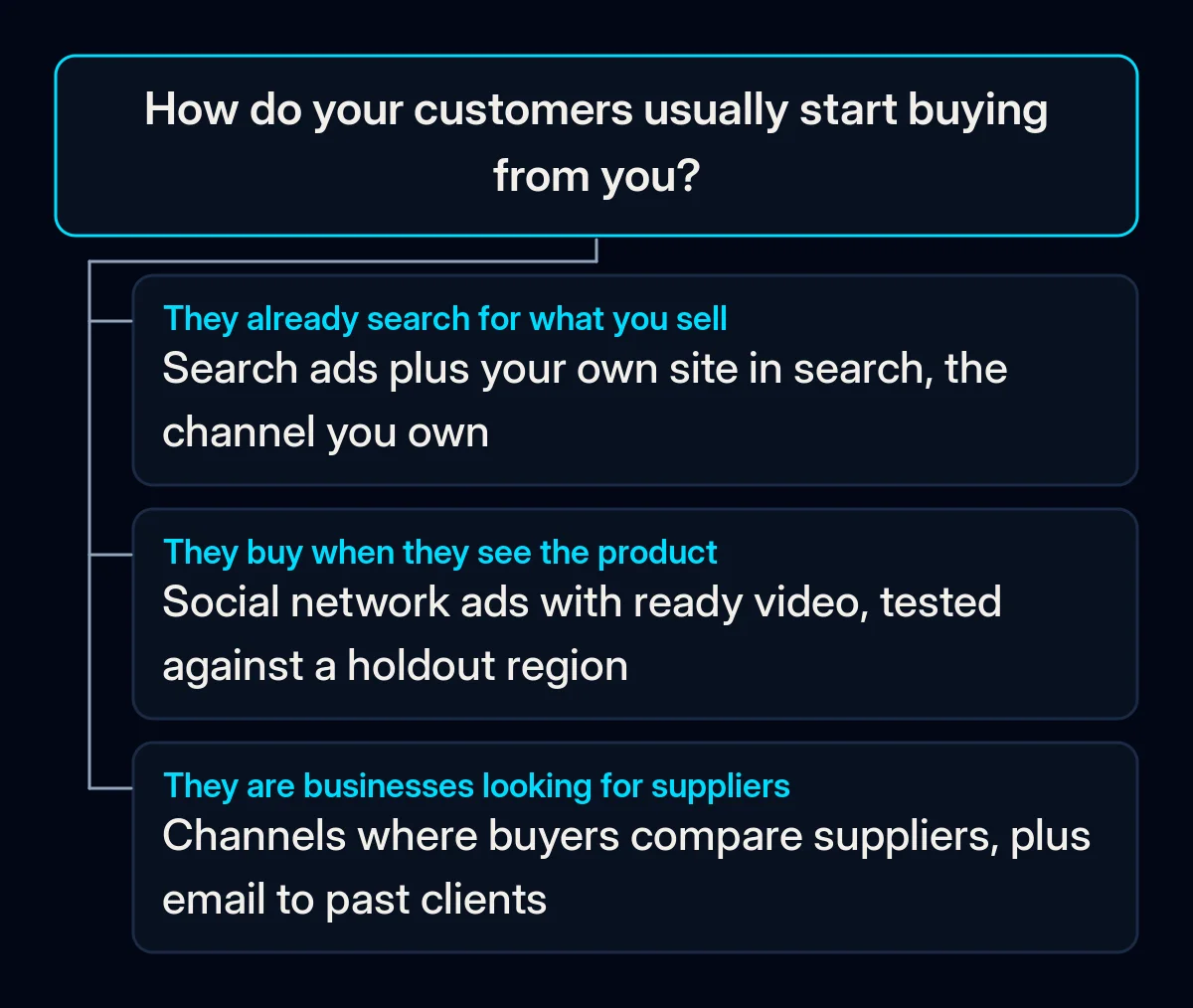
- Pick one second channel by how your customers buy. If people already search for what you sell, search ads and your own site in search fit first. If they buy when they see the product, ads on social networks with ready video fit better. If you sell to other businesses, start with channels where buyers look for suppliers, such as industry directories, LinkedIn or trade events. Budget, video production and the languages you sell in narrow the choice further.
- Set up tracking and handling before the first euro. Put the same labels on every link (UTM tags, which tell your analytics where a visit came from). Send a test enquiry from the new channel and check that it reaches the same list and is assigned to the same person and reply rule as other enquiries. In our paid advertising campaigns we keep to no more than two platforms at the start, so each gets enough budget to show a result.
- Agree the test period and budget in advance, and test against a holdout. A holdout is a part of your market where the new channel does not run, kept for comparison. Purdy & Figg tested TV by “airing ads in only half the country to create a geographic holdout”. Marketing Week reports the brand has no intention of moving budget away from Meta “unless there is a clear commercial case to do so”. Two regions, two cities or two customer groups do the same job at a smaller scale.
- Build the channel you own alongside. Ask existing customers for permission to stay in touch, and make sure your site answers the searches your customers make. It grows slowly and does not depend on any one platform’s account.
Three moves only look like diversification. The first is a second account on the same platform. The second is five new channels at once with a little budget each, and the third is the same ad copied unchanged to a platform where people behave differently.
What to measure after you add a channel
Look at four numbers once a month, taken from paid customers in your CRM or sales list. Judge the new channel only after the test period set before launch, since buyers who need to see you several times before they buy take time to show up.
- The share of revenue from your largest channel, month by month.
- The total number of new customers per month across all channels. If it stays flat while the new channel reports enquiries, the new channel is taking credit for customers you already had.
- Cost per paying customer for each channel, from your own records.
- The share of enquiries with a known source. When it drops, the monthly table by channel stops being reliable.
Where we come in
When we help a business diversify marketing channels, we start with the source field and the monthly table by channel, because they show your real dependency before any money moves. Then we pick one second channel by how your customers buy, set up tracking and lead handling for it, and agree the test with you in advance. If you want to go through your own numbers, a short brief is enough to start.