
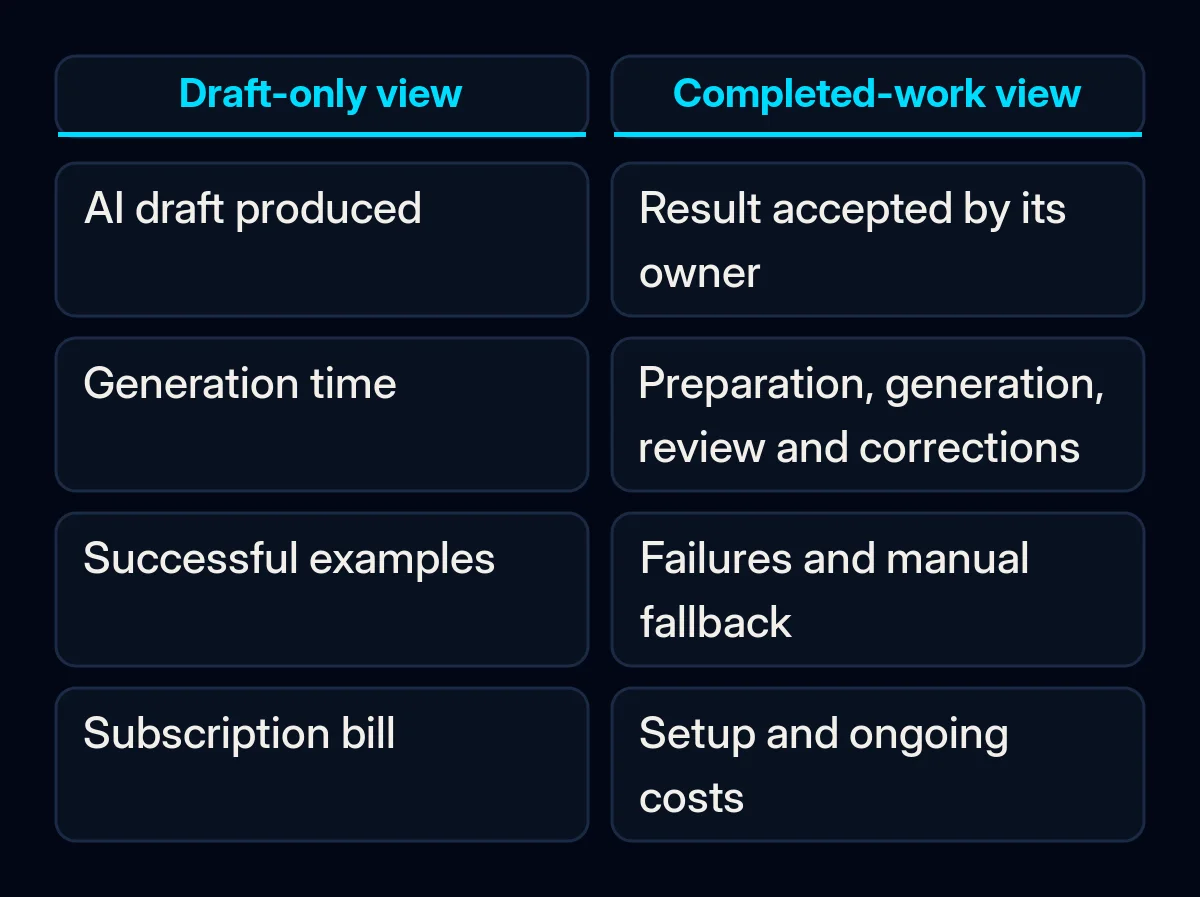
To measure AI ROI, compare the financial benefit you can support with the full extra cost of the pilot, over the same period. First check that the AI-assisted work meets the same acceptance rule as manual work. Count preparation, review and corrections. Record freed staff time separately until you can show what financial benefit it produced.
ROI means return on investment. A pilot is a limited test of a proposed way of working. If the team can show a quick draft but cannot say what it cost to finish the job, measure that job before buying wider access.
Start with the result someone can accept
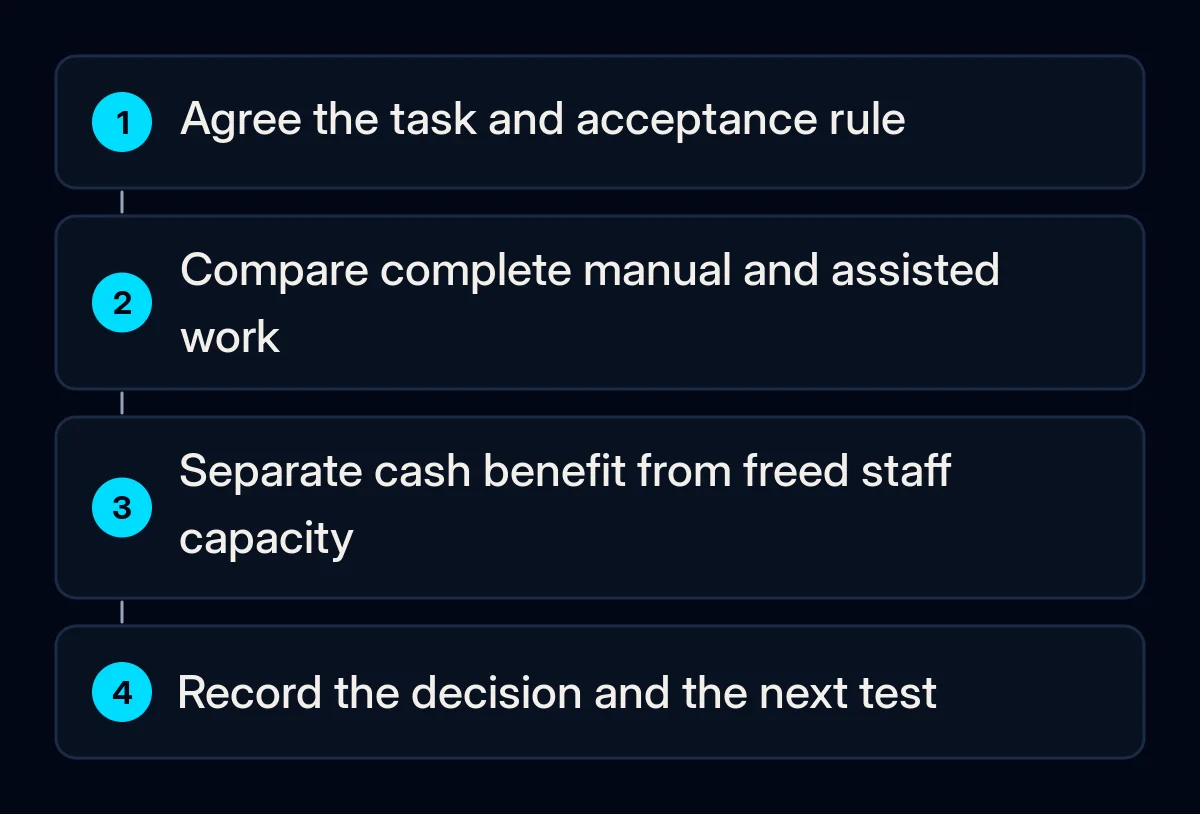
Write down what counts as finished work and who can approve it. Choose a task with a visible result, such as a draft reply checked against approved information and ready for a person to send. Sending it is outside that test unless sending was already part of the authorised process.
Google’s guidance on measuring machine-learning projects separates model performance from business success. It advises defining success measures and agreeing deliverables before the project. Apply that distinction by naming the result you need: less effort per accepted reply, a shorter wait for a checked response, or fewer corrections.
For an illustrative reply-drafting pilot, the acceptance rule could require the correct answer, current terms, an appropriate tone and no unsupported commitment. Keep the same rule for manual and assisted work. Use only information approved for the chosen tool, and leave the existing human approval in place.
Compare the whole job with manual work
Use a record of manual work as your baseline: the reference against which you judge the pilot. Compare similar tasks with similar inputs and the same completion rule. Record differences in difficulty, staff experience or demand. If there is no reliable earlier record, collect a fresh comparison and leave past savings unproven.
- Record the complete manual path. Include finding the information, preparing the result, checking it and correcting it. Add the effort of everyone involved.
- Record the complete assisted path. Include preparing inputs, submitting the request to the tool, checking its response, correcting it and handing it over. If an unsuccessful attempt is finished manually, include that work too.
- Keep the outcome beside the effort. Mark accepted, corrected, rejected or unresolved. Retain failed attempts in the record instead of selecting only successful demonstrations.
- Separate staff effort from waiting. Add the time people actively work when measuring labour. Measure the elapsed time to an accepted result separately if response speed is the goal.
NIST’s voluntary AI risk framework recommends documenting evaluation data, measures and tools, and assessing systems in conditions resembling their intended use. For this comparison, keep a safe, authorised reference to the work and note which workflow version produced it. A limited or biased comparison is a reason to gather better evidence before expansion.
Calculate AI ROI with a clear boundary
The Australian Government’s financial glossary defines ROI through an investment’s net profit relative to its cost. BDC’s guidance also stresses comparing the same investment period. For a pilot, we use the following declared project calculation, with costs greater than zero and costs and benefits in the same currency and period:
Financial pilot ROI = (realised attributable financial benefits - incremental pilot costs) / incremental pilot costs × 100.
Here, incremental costs are the extra costs caused by the pilot. Collect setup, training and integration costs separately from recurring licences, usage, maintenance and oversight.
Include additional review or correction costs without counting labour already included elsewhere. State how shared costs were allocated. Show the full observed pilot cost; identify setup separately when considering what a later period would cost.
Realised financial benefits need evidence of a change attributable to the tested work. A lower supplier invoice for comparable work may support a cash saving. Extra revenue needs its related delivery costs deducted before treating it as a contribution, and other reasons for the change still need checking. Keep estimates labelled as estimates and missing amounts as unknown.
Freed employee time is useful capacity. Record how it was used and what happened next. Multiplying that time by a salary rate gives an estimated value; it does not by itself establish that cash costs fell. Keep a capacity estimate outside this realised-financial-return calculation, and avoid counting the same gain again as a reduced bill.
If benefits or costs are incomplete, report that financial ROI remains unproven. You can still describe observed quality, effort or waiting time. The formula is a transparent pilot measure, with a stated boundary; it does not replace how your finance team accounts for an investment.
What belongs in the pilot record?
Use a sheet you already control. Give each task a reference that authorised staff can follow, and keep customer content out of a broadly shared record. These fields help the process owner trace an observation back to the work and distinguish a measured result from an assumption.
| Record | Manual work | AI-assisted work |
|---|---|---|
| Scope | Task type, inputs and completion rule | Same boundary, with workflow version noted |
| Outcome | Accepted result and any corrections | Accepted, corrected, rejected or unresolved |
| Human effort | Preparation, production, checks and rework | Inputs, handling the output, checks, rework and fallback |
| Money | Comparable existing cost | Extra setup and running costs, with evidence |
| Benefit evidence | Reference level for the chosen goal | Observed change, its evidence and any uncertainty |
For the illustrative reply task, follow a draft through to its approved form. If the checker has to find missing terms and rewrite the answer, retain that effort in the assisted record. If the task cannot meet its acceptance rule, keep it unresolved and use the established manual route.
When the work crosses departments, our CRM and process automation work starts by mapping those handoffs. For your own check, ask each participant what they had to do before the result could be accepted.
Decide what changes after the pilot
Ask the process owner to record the decision, the evidence behind it and what would trigger another test. Quality and authorised use remain conditions of the decision even when the financial calculation looks favourable. NIST’s framework includes deciding whether to proceed and assigning responsibility for disengaging an unsuitable system.
- Stop the assisted path when it cannot meet the acceptance rule or there is no evidence to justify continued spending. Keep the manual fallback available.
- Change and test again when you can identify a fixable problem, such as missing input information or a costly handoff. For a technical change, first clarify which AI approach the task needs.
- Consider expansion when the tested work meets its conditions and the evidence supports the chosen goal. Name the next scope and its owner. Different tasks, users, data access or usage levels need a new comparison.
AWS’s guidance on sustaining AI value notes that operating costs and delivered value change after launch. Continue recording accepted outcomes, complete staff effort, costs and supported benefits. Repeat the assessment after a material change, using the same definitions so the comparison remains useful.
Prepare the rollout decision
Our AI implementation work starts with the task, an acceptance check and comparison with manual work before wider rollout. To prepare your own decision, write the completion rule and name the person who can approve the result. Then collect the evidence for that task through to acceptance, including the work that had to be redone. Use that record to stop, change and test again, or consider expansion for the tested scope.