
To make a website multilingual, start with one language and one complete route for a service you can actually provide. Agree which pages and messages belong in that launch, what visitors will see where a translation is missing, and who will keep it current. Before sending customers there, check the agreed route with your site maintainer and confirm that an authorised test enquiry reaches the responsible team.
Your old blog archive can wait if customers can understand the selected service and contact you without needing it. A useful first task is to make a launch record: a shared list of what will be available, who will check it and what evidence is needed before you open it.
Choose the service and language you can support
Write a short scope statement before ordering translations. Name the audience, the language, the service, the area you serve and the team that will answer enquiries. Adding a language does not mean that the business now supplies every country where people speak it.
For example, suppose an office-cleaning business in Ljubljana wants to serve German-speaking customers in its existing service area. Its first release could cover that service and its enquiry route. A German site for selling products across Europe would be a different project. This is an illustrative scope, not a customer case.
Check the source-language offer with the business owner first. If nobody can confirm what is included in the service or who will answer in German, record that as a blocker. Translating an unresolved promise carries the uncertainty into another language.
Map the pages you will publish and the gaps
Walk through the chosen service on the current site and list every page or message a customer needs before contacting you. Give each a planned target-language URL or write that it has no separate page. Include navigation, form labels, validation errors and confirmation messages in the record, even when they live on the same URL.
Here is a possible first scope for the example business. The paths are illustrative; they are not instructions to rename existing pages.
| Existing item | Planned German version | First-release decision |
|---|---|---|
/office-cleaning | /de/office-cleaning | Required: meaning and availability reviewed |
/contact | /de/contact | Required: fields, errors and confirmation reviewed |
| Relevant contact and privacy information | Agreed pages or notices | Required review for the selected route |
| Old blog archive | No German version yet | Deferred: outside the advertised German scope |
Keep content scope separate from review progress. A required page can still be unfinished. Record both facts, such as “required; awaiting language review”, so the team can tell required pages from ready ones.
Google’s multilingual-site guide recommends separate URLs for different language versions. Agree the URL plan with the current maintainer before changing the site. Website development work can include that mapping and its implementation; buying a translation or a plugin alone does not settle the scope.
Decide what happens when a translation is missing
For each gap, write what the visitor should actually see. A ready equivalent can have a direct language link. For a page outside the release, agree a clear unavailable state or a clearly labelled route to content in another language. Avoid implying that an unrelated homepage is the translated version of the page the visitor was reading.
GOV.UK’s language-navigation guidance, currently in trial, recommends offering a page’s language alternative only when its key information is translated. Use that as a design reference when agreeing which pages the new language option will actually offer.
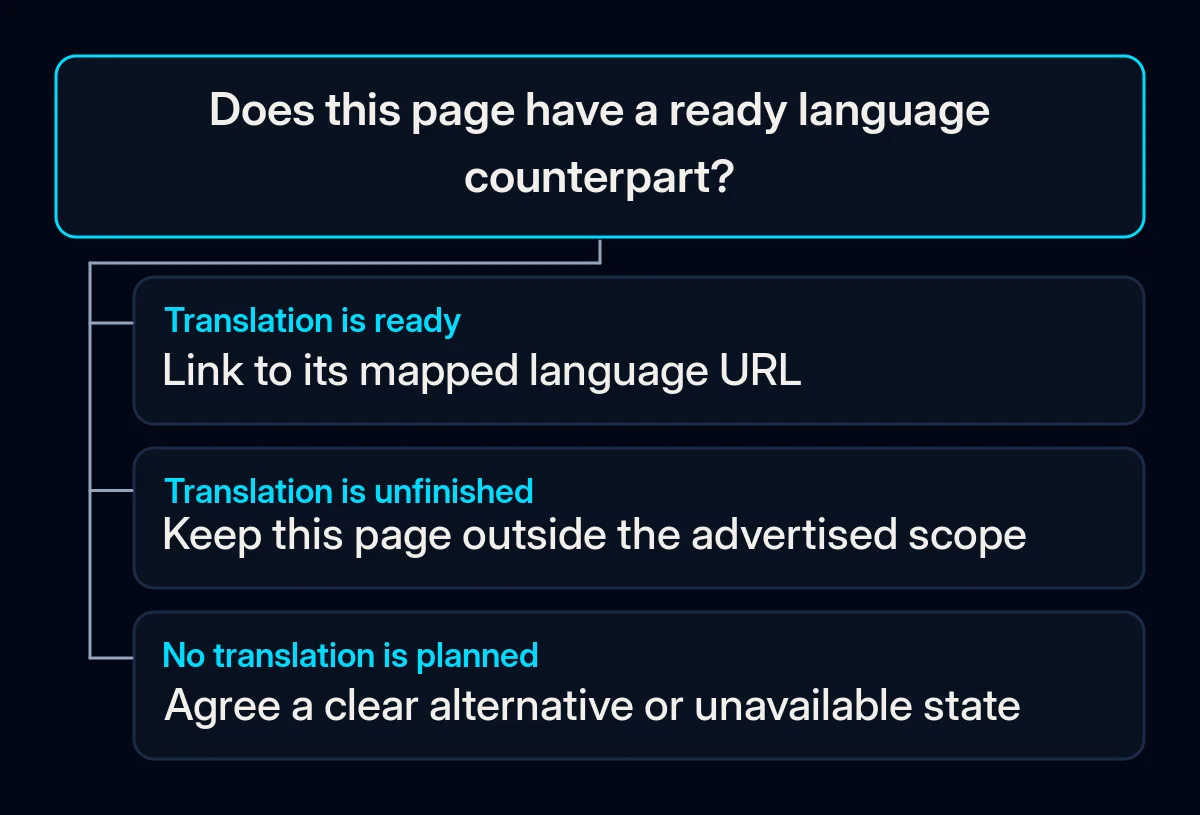
Ask the maintainer to confirm which agreed behaviour the current platform can implement and how it will be checked. Ask whether hiding a language from navigation also makes its direct URLs unavailable; check the actual result. Treat “not linked”, “not published” and “not ready” as separate observations, and record the intended exposure before anyone starts a campaign.
Keep the existing source-language route available during preparation. Automatic redirects or a menu change can affect visitors outside this small release, so changes to those behaviours need their own review and a way to restore the previous working route.
Give each check an owner and a place for evidence
Assign who checks the meaning, who confirms the service and contact arrangements, and who checks the implementation. Name the receiving team and the person responsible for later source changes. One person may cover several roles, but “the translation team” is too vague to decide who fixes a missing contact notification.
Use your existing document or spreadsheet. Copy this record and fill it in for each required part of the route:
- Scope and version: audience, language, service, service area and review date.
- Page or state: source item, planned target URL or message, required or deferred status, and missing-translation behaviour.
- Owners: meaning reviewer, business approver, technical maintainer, enquiry recipient and future-update owner.
- Evidence: what was checked, the expected and actual results, tested URL, device or browser, date, and who checked it.
- Open issue: what blocks release, who will fix it and what must be checked again.
- Decision: ready or on hold for this scope, who accepted it, and the condition for another review.
For the technical review, include the page’s declared language. W3C’s HTML guidance recommends setting it with the lang attribute on the HTML element; ask the maintainer to check that it matches the content.
Have a person able to judge the target-language meaning read the offer and the required messages. Check what is included, what is excluded and what the visitor is being asked to submit. A fluent sentence can still describe a service your business does not provide.
Test the agreed route, then decide whether to launch
Before submitting anything, agree a safe test with the site owner and the receiving team. Use recognisable test data and an authorised destination. If the route could make a real booking, payment or other commitment, arrange a safe test method with the maintainer first. Keep the release on hold when that cannot be done safely.
- Open the agreed target-language entry URL and follow the mapped route. Check language links, deferred-page behaviour and the actual destination of each required link.
- Check the service text and contact information, then test the agreed form states. Record missing labels, unclear errors, unexpected language changes and mobile display problems.
- Send the authorised test enquiry. Record its test marker, submission time and the confirmation shown, without using a real customer’s details.
- Ask the responsible recipient to find the matching enquiry in the agreed inbox or system. Save confirmation of that receipt separately from the website’s success message.
- Record each defect and recheck the affected part after it is fixed. Have the business approver record whether this specific scope is ready to open or remains on hold.
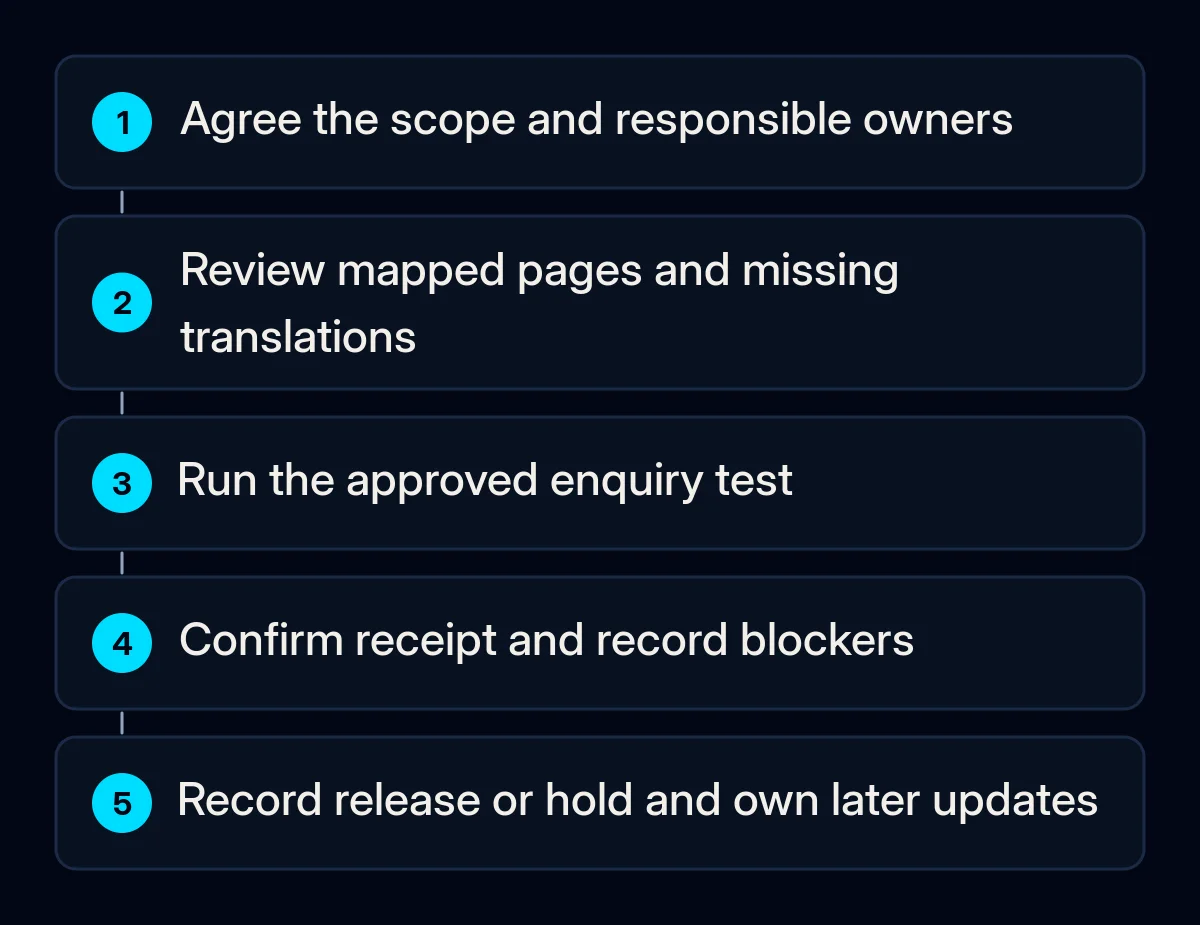
A thank-you screen or an analytics event does not establish that the responsible team received the enquiry. If the enquiry is missing, keep the evidence and ask the maintainer or CRM and automation team to trace the agreed route. Sending repeated submissions without checking can create duplicate work while leaving the cause unknown.
Open the agreed scope when its required items have passed, its missing-content behaviour is clear and the responsible team has confirmed the test receipt. An untranslated archive can stay deferred if the advertised route does not depend on it. A broken required contact step, an unresolved service promise or a missing approver keeps that scope on hold.
The result covers the route and conditions you recorded. It does not establish that every device or form state works, that search engines have indexed the pages, or that all accessibility and legal requirements have been assessed. For an already published site where search shows the wrong language, use the separate wrong-language Google checks.
Keep the record when the original changes
When the service, contact route or source text changes, ask the update owner to mark which translated items are affected. Update those items and repeat the relevant checks before treating them as current. A new recipient, for example, calls for another receipt check; a changed service exclusion calls for meaning and business review.
Keep the previous accepted record alongside the new decision. That lets the team see what changed and which checks remain open, rather than relying on a language version’s original launch date.
Where we come in
We start with the service route, the content gaps and the people responsible for acceptance. We can map the first language release, implement the agreed behaviour and trace its enquiry handling with your team. An existing site and a draft scope are useful starting points for a website brief.